Foreword to A Solution for the Third Millenium
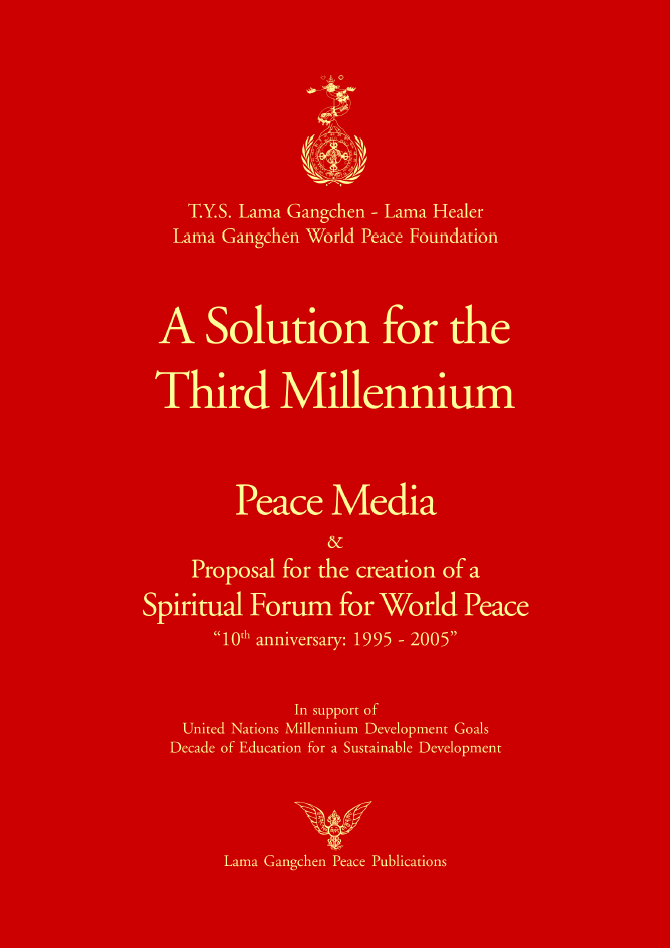
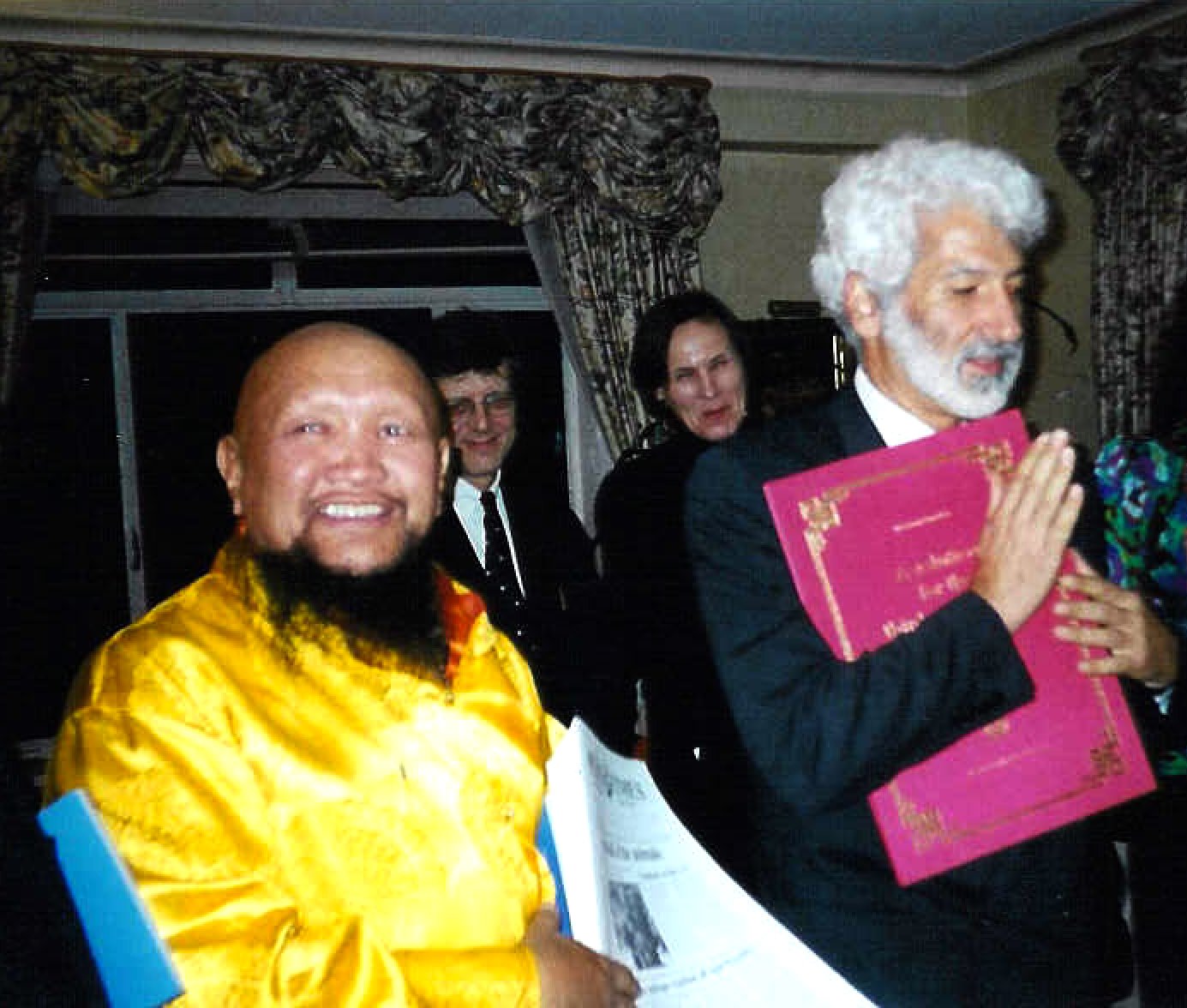
Alfredo Sfeir-Younis, serving as the Special Representative of the World Bank to the United Nations, provides a personal and systemic critique of modern development in his foreword to A Solution for the Third Millennium
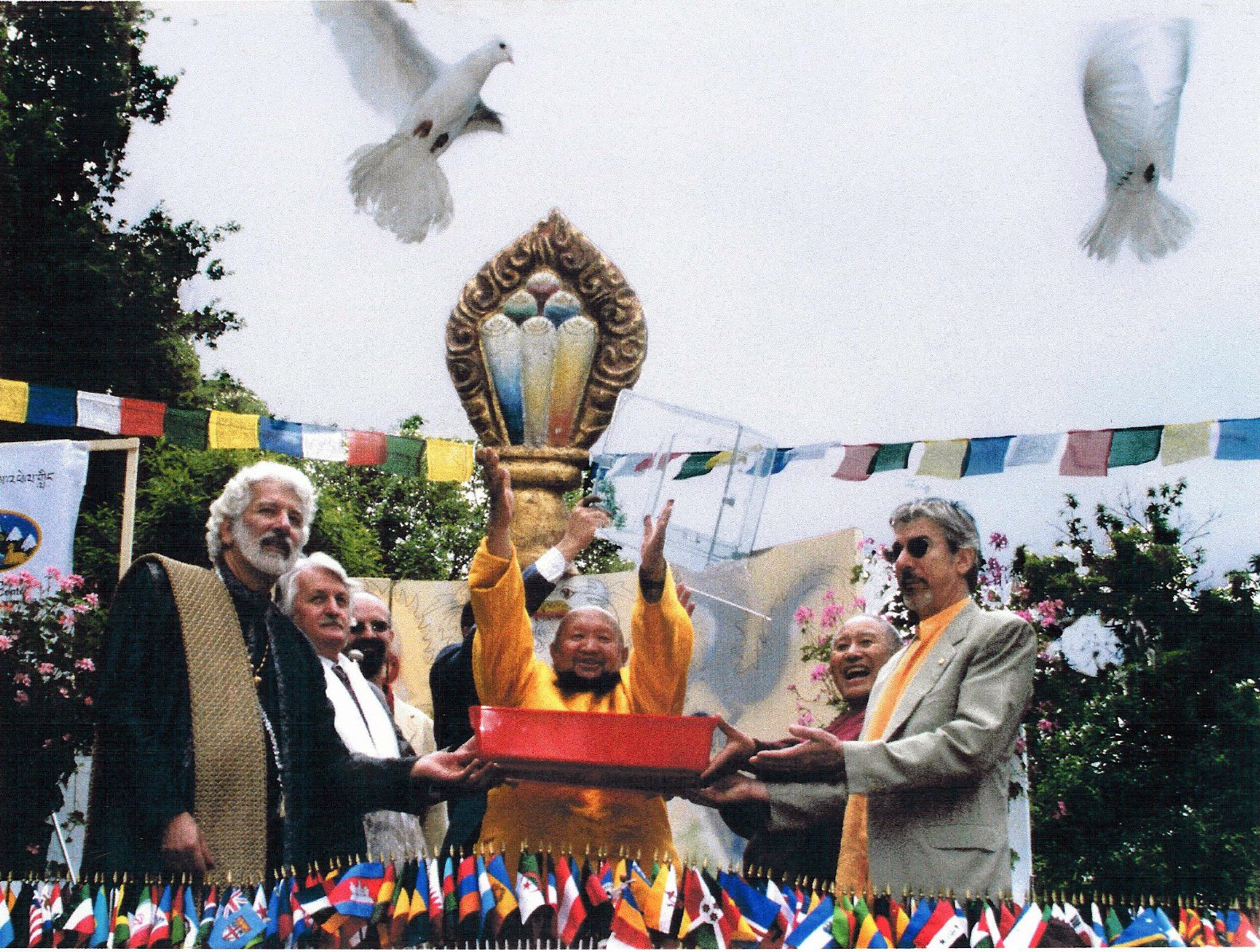
As we prepare to cross the cosmic gate which signals that we are part of this Planet’s life in the next millennium, this book must be one of our essential companions. I must confess that my primary and secondary education, BA, MS and Ph.D. did not prepare me to address many aspects of my every day life. Despite many years of formal education, these did not contribute much to teach me how attain peace on Earth and, more importantly, how to attain my own inner peace. That is why I believe this book is one of the most beautiful gifts that Lama Gangchen has given to humanity!
Reading this book (more than once) will enliven your hearts, as you will begin to see his clear vision of where humanity should be. This book presents in simple words his profound and unique understanding of life on Earth. It opens the holy space we all are searching for to finally live that personal encounter with the fundamental solutions to our uncertain future. A very beautiful collection of powerful messages on how to «Create a Peaceful Media Environment». Each chapter enlivens a singular aspect of our existence in ways I never thought it was possible. Reading this book felt like a masterfully crafted inner experience of becoming one’s own reality and acquiring holistic self-empowerment. His thoughts will assist all of those who are trying to conquer their fears and will touch on the most intimate mechanisms of our existence.
As the next millennium approaches so rapidly, I always thought that the time has come to reflect on our achievements. It seems fundamental to evaluate our actions in relation to what we have accomplished as we attain different (hopefully higher) levels of welfare. However, after reading this book, more than once, I came to the realisation that such evaluation is not sufficient. The perspectives of Lama Gangchen call also for an evaluation of the legacy we are leaving behind, as our societies get (hopefully) better off. In essence, it is not a matter of what one has accomplished (as a person or as a society), but of what we have left for future generations.
Let us look at the record. From the point of view of our achievements, there seems to be a consensus that the «material» balance sheet of the world is much better than ever before. In terms of literacy, life expectancy, access to essential material goods and services, and the like, the last generations have not done so bad. Technological change has been one of the essential ingredients, allowing us to shorten distances; to communicate better, faster and cheaper; to understand life here on Earth and in other planets; to eliminate major diseases; to increase the productivity of our lands and avoid unnecessary famines, and so on.
However, in terms of our legacy, we see something more disheartening. Specifically, we see that in spite of the billions of dollars spent in the name of economic development, there are still 1.3 billion people who live with less than a dollar a day, and more than half a billion people who suffer from severe malnutrition. Furthermore, there are approximately 600.000 women who die every year of complications during pregnancy and childbirth because they do not have access to health care, and there are thousands of children who die every day of diseases whose cures are well known. This is a century that will be remembered as one that left a legacy entitled «poverty».
The same fragile balance permeates our natural environments, as the tropical rain forests are being depleted at alarming rates, wildlife and other bio-diversity resources are not sufficiently managed or protected, water and air pollution of many sorts are at its highest levels… This is a century that will be remembered as one that left a legacy entitled «environmental destruction».
But, there is another dimension of this legacy: our inability to attain peace and social stability on Earth. And, this is where the book becomes mandatory to all of those who are engaged in decision-making. When historians begin to look back at the 20th Century, they will not only report on World War I and II – where so many people were killed and so many nations destroyed. In addition, they will report on the more than 100 wars or civil strifes that have taken the life of nearly 30 million people. This will not be remembered as the century of peace. This century did not look at peace as the source of empowerment for humanity; on the contrary, empowerment has been sought through an arms race of alarming proportions that has become the most important threat to life on this planet. There has been the arms race by all nations – not only the rich nations – which has been used as an instrument of peace and stability. An approach that could not be farthest away from the sources and foundations of peace!
This is a century that will be remembered as one that left a legacy entitled «social deterioration and instability».
As one understands better the demographic projections regarding our future (e.g., population and urbanisation in the world), it is now clear that we will see the doubling of the world population in the early part of the next millennium. Thus, there will be a very large number of crowded cities, particularly in developing countries, and we are seeing that the risks of increased crime, drug addiction, social deterioration, unemployment, and the like, are extremely high. Therefore, it will not be unreasonable to expect a world with a large mass of younger people looking for work and an equally large group of elderly persons to whom the «productive» strata of the population will have to take care of.
All the economic, financial, social, ecological and political crises of today are the mirror images of the major spiritual crisis that the world lives today. Good economics is only a necessary condition to eradicate the economic crises. By the same token, all the good financial, social, ecological and political practices within our societies seem to be several steps removed from the real and sustainable solution to their problems. And, it is no surprise then to see a number of paradoxes facing humanity today (e.g., food production is significant while malnutrition still exists, growth of material welfare is at its peak while poverty continues to increase). In the final hour of the day, actions confined to the economic, financial, ecological, social and political fields are just short-term palliatives.
Lama Gangchen’s message is clear in this respect: the real solution to major world problems requires us to adopt a set of «superior» values and goals that can only be developed and sustained within the inner space of our lives. This book tells us that there is only one way out from these crises: peace. And, that peace is the sharp and shining diamond that must be used to carve a real and lasting prosperity on Earth. Now is the time to reflect upon our existing approaches to development and social change. We should ask ourselves if these are effective or even suitable to address the above mentioned legacies. This book teaches us that major transformations need to take place, and that these have their origin exactly in the opposite «space» we have been using and relying upon in the past.
The major lesson today is that the transformation process must start with inner change rather than with outer change. This is to say that: the source of peace and security is rooted in ourselves; the roots of change will not come from changing the outer notion of our lifestyles, but rather as a result of higher levels of consciousness and behaviour; and the quality of development and change will depend mainly on the quality of our decisions and our choices, all of which are a mirror image of our inner souls.
At the foundation of Lama Gangchen’s message there is a key principle I fully share: that peace is the only source of (material and non-material) wealth and prosperity, environmental healing and conservation, and social stability. The messages in this book show that a single-barrel approach to the creation and distribution of material wealth – enhanced through economic, social and political decisions anchored in the outer world – is not enough to resolve the fundamental problems we will face in the next millennium. It is a fact that today’s global problems need a different set of solutions. We have reached some level of «economic and financial fatigue». We have also reached «political fatigue». The world cannot depend only on such outer mechanisms, without understanding fully that at the root of markets and governments lies each and every one of us. We are the pillars of all the instrumentality we see «outside» us.
This book teaches us another way of making decisions: it teaches us that there are inferior and superior instruments to pursue progress or welfare enhancement and that we seem to be using inferior instruments to achieve superior states of human welfare; it teaches us that «peace» is a superior form of human welfare, and superior to any other objective we may articulate in the context of economic and social development. As long as we delay bringing peace to the core of decision making, the puzzle will always lack in essential pieces to make this a different world.
The beauty of Lama Gangchen’s principles and philosophy is its simplicity. Our reality is essentially simple. Our life is simple. The truth is simple. He teaches us that fear, misunderstanding of who we are, our misconstrued attitudes towards money and wealth, our language and behavioural patterns, and some parts of our value and belief system have become the most effective blindfolding mechanism of our hearts and souls. We are the ones who make every aspect of life complicated!
Within this context, Lama Gangchen: focuses on non-formal education as a centrepiece for teaching the real foundations of peace; assesses the media and its importance for peace making and peace loving; points out who is responsible for peace – all of us!! -; sees how even sports can be a source of peace or of its destruction; shares his vision of inner transformation and self-healing which begins not in the science but in the intuition and feeling level of humanity; assists us in walking from separation and duality – the here and there, the outer and the inner, the matter and the non-matter – to the essence of who we really are: oneness (one in all and all in one).
The most powerful realisation comes when the heart begins to read the book rather than our eyes or our brain. As the heart takes over, one begins to really understand peace environment, peace economy and peace development and progress. The boundaries between individual and collective actions or between individual and collective responsibilities begin to disappear, to enter into our world with total unity in purpose. Where, for example, the meaning of the word «globalisation» goes far beyond simple notions of trade and finances; rather, it penetrates into the foundations of who we really are and into our collective mission and responsibilities. Thus, a person’s pain from the negative impacts of globalisation becomes the pain of his or her community, the pain of the community becomes the pain of the nation, and the pain of any nation becomes our collective suffering.
The book brings Lama Gangchen’s gift of transformation, from a paradigm of «to fit or not to fit» or «to win or not to win», to what was expressed so well by William Shakespeare: «to be or not to be». It is a call for bringing the economic, social, environmental and political structures we are so involved in these days into the «peace» and «being»
Thanks, Lama Gangchen for bringing to us the real message of peace on Earth. But most importantly, thank you for being the essence of peace!
Alfredo Sfeir-Younis
Foreword to A Solution for the Third Millenium
Peace Media & Proposal for the Creation of a Spiritual Forum of World Peace
“10th Anniversary:1995 -2005”
In Support of United Nations Millennium Development Goals
Decade of Education for a Sustainable Development
by T.Y.S Lama Gangchen – Lama Healer
Lama Gnagchen World Peace Foundation
Lama Gangchen Peace Publications
Follow Us